
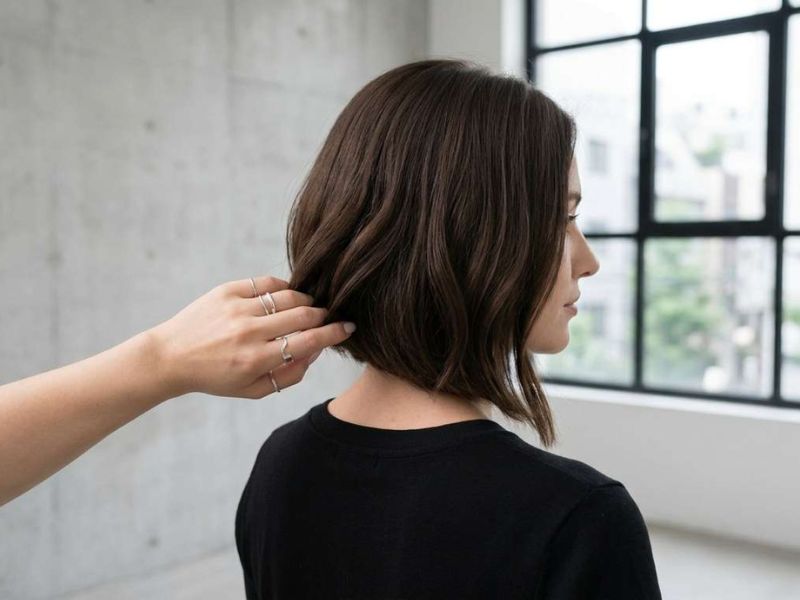
If there is one haircut that perfectly captures the spirit of beauty — intentionally off, unexpectedly chic, and deeply personal — it is the asymmetrical lob.
The asymmetrical lob, or A-lob, is a long bob where one side is cut noticeably longer than the other, creating a diagonal, angular line that frames the face with a dramatic, fashion-forward edge.
It is modern, versatile, and — once you understand the basics — very achievable whether you are visiting a salon or doing a careful trim at home.
This guide covers everything: what the cut actually is, how it compares to a regular lob, which face shapes it suits, how to cut and style it at home, and how to maintain it. Let us get into it.
Also read: Lob Hairstyles for Fine Hair That Look Fuller and Feel Easy
What Exactly Is an Asymmetrical Lob?
A lob — short for long bob — is a haircut that typically falls between the chin and the collarbone. A regular lob cuts both sides to the same length.
An asymmetrical lob deliberately cuts one side longer than the other, creating a sweeping, angled line from back to front or from one side across to the other.
The degree of asymmetry is entirely up to you. It can be subtle — just an inch or two of difference — or bold, with one side grazing the jawline while the other reaches the collarbone.
Deep side parts are almost always paired with this cut because they make the uneven lengths visible and intentional rather than accidental.
Asymmetrical Lob vs Regular Lob: What Is the Difference?
Before deciding if this cut is right for you, here is a side-by-side comparison of both styles.
| Feature | Regular Lob | Asymmetrical Lob |
| Length | Same on both sides | One side longer than the other |
| Shape | Horizontal, even cut | Angled, diagonal cut |
| Face framing | Symmetrical framing | Dramatic, one-sided framing |
| Best for | All face shapes equally | Round, square, heart faces |
| Styling time | Quick, minimal effort | Slightly more (to show the angle) |
| Personality | Classic, understated | Edgy, modern, fashion-forward |
| Trend status 2026 | Evergreen staple | +85% Pinterest search surge |
Bottom line: if you love the lob but want something with more personality and visual interest, the asymmetrical version is your answer.
Which Face Shapes Suit an Asymmetrical Lob?
One of the biggest advantages of the asymmetrical lob is how adaptable it is. The angle can be dialed up or softened to flatter almost any face shape. Here is exactly how to match the cut to your features.
| Face Shape | Best Variation | Why It Works |
| Round | Deep side part, longer front pieces | Creates the illusion of length and elongates the face |
| Square | Soft angled lob with waves | Softens the jawline and adds feminine movement |
| Heart | Longer front, shorter back A-line | Draws attention downward, balances wide forehead |
| Oval | Any variation — you have the ideal canvas | Oval faces suit virtually every lob style |
| Long / Oblong | Slight asymmetry, avoid deep side parts | Keeps length from looking too stretched |
| Diamond | Soft asymmetry with face-framing layers | Adds width at chin, balances narrow forehead |
How to Do an Asymmetrical Lob at Home: Step-by-Step
Important note before you begin: trimming your own hair for a clean asymmetrical lob is possible but requires care. If you are making a dramatic length change — more than 2 inches — consider visiting a stylist for the initial cut and maintaining it at home afterward. For small trims and touch-ups, the steps below will guide you through safely.
What You Need
- Sharp hair-cutting scissors — never use regular scissors, they crush the hair ends
- A fine-tooth comb and a sectioning clip
- A handheld mirror plus a wall mirror for checking the back
- Hair clips to separate sections
- A water spray bottle
- A ruler or measuring tape (optional but helpful)
Step 1 — Wash, Condition, and Towel Dry
Start with clean, damp hair. Wet hair is easier to cut accurately because it lies flat and stretches to its true length. Do not cut completely dry — dry hair springs up and contracts, making it very easy to cut more than intended.
Step 2 — Detangle and Part Your Hair
Comb your hair completely smooth and remove all tangles. Decide where your part will live — a deep side part is the classic choice for an asymmetrical lob because it naturally creates the longer and shorter sides. Clip the heavier side out of the way to start.
Step 3 — Establish Your Guide Length on the Longer Side
Work on the longer front side first. Pull a section straight down alongside your face and decide where you want the longest point of the cut to fall — typically between the collarbone and the jaw.
Cut this guide section straight across. This is your anchor length for everything that follows.
Step 4 — Create the Diagonal Angle
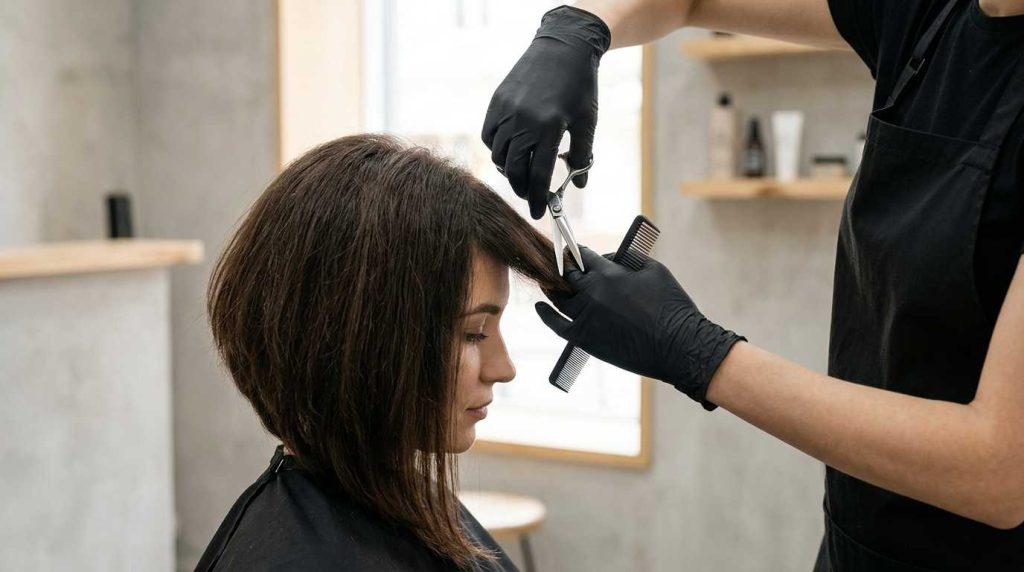
This is the defining step. Working from the longer front side toward the back, begin combing sections straight down and cutting them at a slight upward diagonal — shorter as you move toward the back. The angle should be gradual and consistent.
Check both sides in the mirror frequently. The goal is a clean sweeping line from the longer front to a shorter back, not a sudden choppy jump.
Step 5 — Cut the Shorter Side
Unclip the shorter side and decide how much shorter it will be relative to the long side. For a subtle asymmetry, keep this side one to two inches shorter.
For a bold editorial look, the difference can be three to four inches or more. Cut the shorter side straight across at your chosen length, then blend it with a very slight angle toward the back so it connects cleanly with the longer side.
Step 6 — Point Cut the Ends
Instead of cutting straight across in one blunt motion, angle your scissors vertically into the ends and make small snipping motions — this is called point cutting.
It softens the line, prevents a blocky finish, and gives the cut that expensive, professional look. Run through all sections with this technique at the very end.
Step 7 — Blow Dry and Check the Shape
Blow dry your hair straight using a round brush, pulling the hair downward and outward. Only when it is completely dry can you fully evaluate the asymmetry.
Check the angle from the front and both sides using your mirrors. Make any final small adjustments on dry hair, snipping conservatively — you can always take more off, but you cannot put it back.
How to Style Your Asymmetrical Lob: 5 Different Looks
The asymmetrical lob is one of the most versatile haircuts you can have because the angle itself does most of the visual work. Here are five different ways to finish the style depending on your mood and occasion.
| Style Finish | Tools Needed | Best For |
| Sleek & straight | Flat iron + shine serum | Office, formal events, date nights |
| Soft waves | 1-inch curling wand + mousse | Everyday wear, casual outings, brunches |
| Glassy curved | Round brush blow-dry + flat iron | Red carpet, special occasions, photos |
| Textured tousled | Diffuser + texturizing spray | Effortless daily look, beach days |
| Pinned back asymmetry | Bobby pins + light hairspray | Showcasing the angle on hot days |
For Sleek and Straight
- Apply heat protectant to damp hair and blow dry smooth using a paddle brush.
- Take small sections and run a flat iron through them from root to end.
- On the longer side, bend the very ends slightly inward so the tip curves toward your jaw.
- Apply a pea-sized amount of shine serum to the ends and run fingers through once.
- Finish with a light mist of anti-frizz or shine spray.
For Soft Waves
- Apply a lightweight mousse to damp hair and rough-dry with a diffuser or blow-dryer.
- Take 1-inch sections and wrap them around a curling wand, alternating direction for a natural finish.
- On the longer side, always curl away from the face so the angle stays visible rather than hidden.
- Let curls cool, then shake out gently with fingers. Do not brush.
- Mist with a flexible-hold hairspray to maintain movement without stiffness.
Essential Products for an Asymmetrical Lob
The right product kit makes the difference between a lob that looks salon-fresh and one that falls flat by midday. Here is exactly what to keep in your kit.
| Product | Purpose | Pro Tip |
| Heat protectant spray | Shields hair from flat iron & wand heat | Apply to damp hair before blow-drying |
| Flat iron (1–1.5 inch) | Creates the sleek, sharp angle line | Use 365°F or lower to prevent damage |
| Round brush | Adds volume and smooth blow-dry base | Pull outward on the longer side for the swing |
| Lightweight texturizing spray | Adds grip and lived-in texture | Mist at the roots before styling |
| Shine serum or gloss spray | Seals the ends for that expensive finish | Apply only to mid-lengths and ends |
| Strong-hold hairspray | Keeps the asymmetric angle visible all day | Spray from 12 inches away for soft hold |
How to Maintain Your Asymmetrical Lob
The asymmetrical lob is considered one of the lower-maintenance fashion cuts, but it does need regular attention to keep the angle sharp and the shape intentional rather than grown-out looking.
- Trim every 6 to 8 weeks. This keeps the asymmetric angle crisp. The longer side grows faster in appearance, so trims are important to maintain the ratio between both sides.
- Use a bond-strengthening treatment monthly if you regularly use heat tools. This keeps the ends from becoming brittle or splitting, which would blur the clean line of the cut.
- Protect the ends. The longer side especially needs moisture and protection since it is the star of the look. Use a nourishing hair oil on the ends two to three times per week.
- Deep condition weekly if your hair is color-treated. Dark hair colors that complement this cut — deep brunette, burgundy, balayage — require extra moisture to stay glossy and healthy.
- Sleep on a silk pillowcase. This reduces friction and prevents the ends from fraying, keeping the cut looking polished between washes.
Popular Asymmetrical Lob Variations to Try in 2026
The asymmetrical lob is not one fixed look — it is a framework you can customize endlessly. Here are the most sought-after variations on Pinterest right now.
The A-Line Asymmetrical Lob
The back is cut shorter and stacks up, while the front pieces angle forward longer. It creates a dramatic diagonal line when viewed from the side. This is the boldest, most editorial version of the cut.
The Subtle Asymmetrical Lob
Only one to two inches of difference between sides, styled with soft waves. It reads as deliberately stylish rather than dramatically edgy — perfect for workplaces or anyone dipping their toe into asymmetry for the first time.
The Layered Asymmetrical Lob
Internal layers are added throughout the cut for movement and volume. The asymmetry is still visible but the layers give it a softer, more romantic feel. Ideal for thick hair that needs weight removed.
The Textured Choppy Asymmetrical Lob
Point-cutting is used aggressively throughout the cut to create a deliberately uneven, shaggy texture on the ends. This is the most Glitchy Glam version of the style.
Frequently Asked Questions
Is the asymmetrical lob difficult to maintain at home?
It is one of the easier fashion cuts to touch up at home between salon visits. As long as you trim conservatively — a little at a time — and follow the angle established by your original cut, maintaining the shape is straightforward. The key rule is to always point cut the ends rather than cut straight across.
Can I get an asymmetrical lob if my hair is curly?
Yes, but the asymmetry will read differently when curls are in their natural state versus when straightened. Your stylist should cut the asymmetrical lob on dry, naturally curly hair so the angle is visible in both states. Let your stylist know you plan to wear it both ways so they can adjust the angle accordingly.
How much shorter should the short side be?
For a subtle look, one to two inches of difference is enough to show intentional asymmetry without looking dramatic. For a bold editorial statement, three to four inches or more creates a strong visual contrast. Most people start subtle and go bolder once they are comfortable with the cut.
Will the asymmetrical lob suit me if I have fine hair?
Yes — and it is actually particularly flattering for fine hair. The diagonal angle creates the optical illusion of more volume and density. Avoid very heavy blunt cuts and ask for light point-cutting throughout, which makes fine hair look thicker and more textured.
Final Thoughts
The asymmetrical lob is not just a haircut — it is a statement of confidence. It says you understand that perfection is overrated, that an intentional off-balance is more interesting than a perfectly even line, and that the best style is the one that feels unmistakably yours.
Whether you go subtle with a one-inch difference and soft waves, or bold with a dramatic A-line angle and sleek straight styling, the asymmetrical lob adapts to your hair type, your face shape, and your personal aesthetic with remarkable ease.